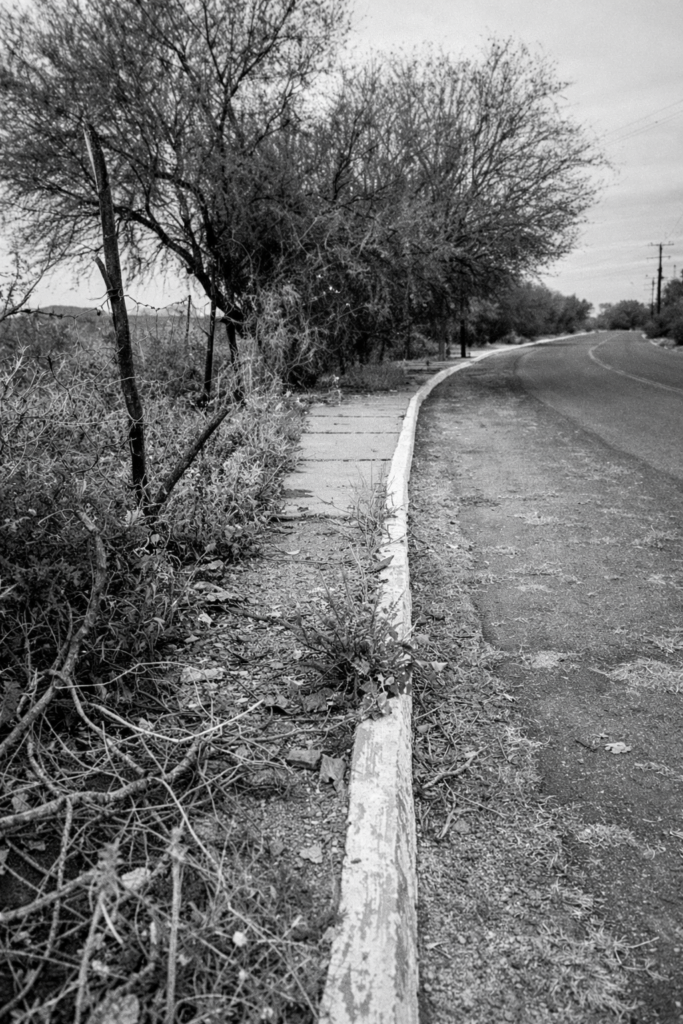
I took this photograph along a roadside in Loreto, where a concrete sidewalk curves into the distance beside an empty road. The path exists. It was built. Someone poured the concrete, painted the curb white, laid the slabs in sequence. Yet no one walks here. Dry brush spills across the surface. Leaves gather in the cracks. The paint is chipped and faded. The sidewalk has become a relic of intention rather than a site of use.
In black and white, the image becomes a study in neglect. The curving white line of the curb draws the eye forward, but the path it borders leads nowhere I can see. Bare trees lean overhead, their branches tangled and sparse. A barbed wire fence marks a boundary to the left. Power lines recede into the distance on the right. The infrastructure of connection surrounds a path that connects nothing. I am drawn to built environments that have outlived their purpose.
Sidewalks no one uses. Benches where no one sits. Spaces designed for bodies that never arrived or have long since departed. These places hold a particular kind of quiet. They are not ruined. They are simply abandoned in plain sight, maintained just enough to remain visible, forgotten just enough to fall into disrepair.
This photograph speaks to what I have come to call malperformative inclusion in my scholarly work. The sidewalk performs accessibility. It demonstrates that someone, somewhere, considered pedestrians. Yet the path itself resists walking. The brush encroaches. The surface crumbles. The infrastructure exists without function, a gesture toward accommodation that accommodates no one.
In my broader practice, images like this become evidence of the gap between what is built and what is sustained. The sidewalk was never the problem. The problem is what happens after the concrete dries. Who maintains the path. Who clears the brush. Who ensures that what was promised continues to be possible. The curb still curves into the distance, white and certain. The path beside it waits, empty and overgrown, for feet that do not come. Photo Credit: Amy Tucker, 2026