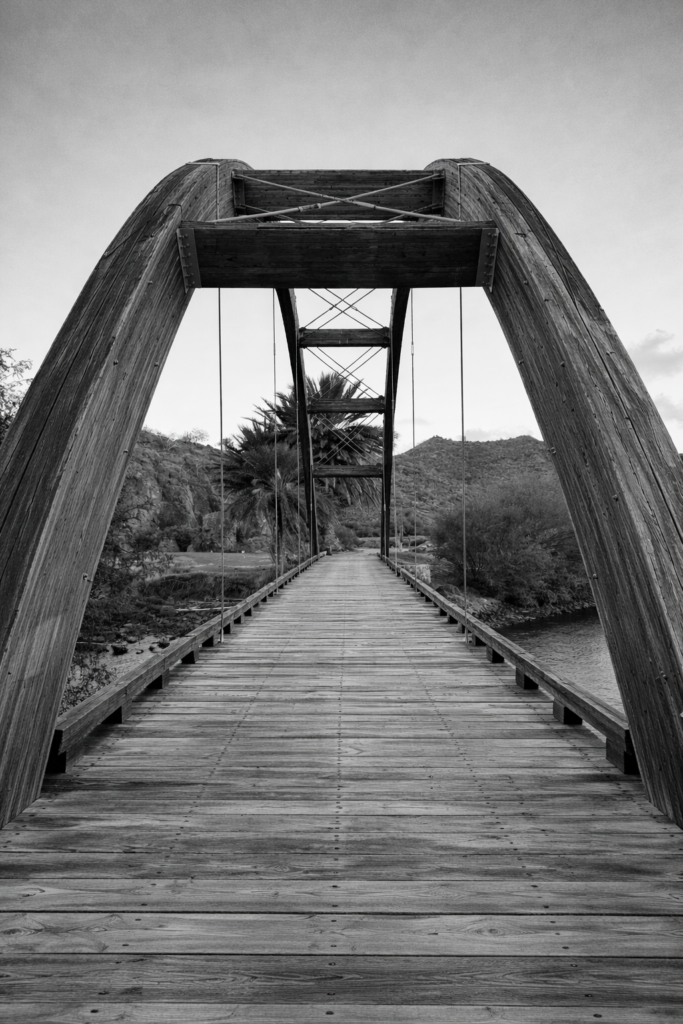
I almost did not take this photograph because I was nervous about being caught. But that nervousness was part of the play. Risk, within safe limits, is part of what makes play exhilarating.
Brian Sutton-Smith (1997), a leading play theorist, argues that play always involves some element of uncertainty and a negotiation between order and chaos. Play is not the absence of rules but rather the creative engagement with them, the testing of edges, the willingness to see what happens when boundaries are approached rather than avoided.
Walking across this bridge in the dark, I was negotiating. I was playing with boundaries. I was remembering what it felt like to be young and bold and willing to break small rules for the sake of beauty. The bridge stretched ahead of me, lit from below, its railings forming parallel lines that converged toward a vanishing point I could not quite see. The darkness pressed close, but the light held the path. I walked quickly, heart quickened, aware that I was somewhere I perhaps should not have been, yet drawn forward by the image I knew was waiting.
Play scholars remind us that play is not frivolous. It is a fundamental mode of learning and being. Huizinga (1938) described play as existing outside ordinary life, a stepping into a temporary sphere of activity with a disposition all its own. That evening on the bridge, I stepped outside. I entered a space where the usual rules softened, where risk became invitation, where the possibility of being seen doing something small and unsanctioned made the photograph feel earned rather than taken.
In my broader practice, I am learning to notice when play emerges in unexpected places. It arrives in the willingness to cross a bridge at night, to raise a camera when caution says to keep walking, to honour the part of myself that still wants to break small rules for the sake of seeing something beautiful. The nervousness did not disappear. It became part of the image, held in the tension between light and dark, between permission and trespass. Photo Credit: Amy Tucker, January 2026
References Huizinga, J. (1938). Homo ludens: A study of the play-element in culture. Beacon Press. Sutton-Smith, B. (1997). The ambiguity of play. Harvard University Press.