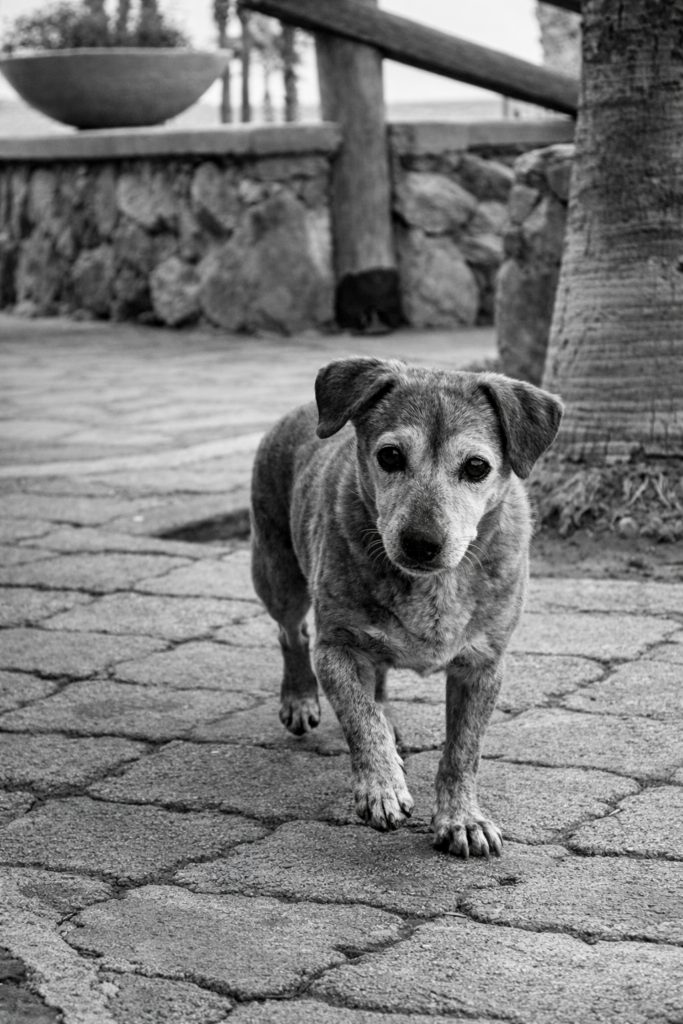
I took this photograph on a stone path in Loreto. A small dog was walking toward me, unhurried, its gaze steady and open. I did not call to it. I simply waited, and it came.
In black and white, the moment becomes something other than a snapshot of a passing animal. The textures sharpen. The stone path, worn smooth by feet and time. The soft blur of fur against hard ground. The shadow that stretches behind the dog, marking the angle of late light. Without colour, what remains is form, movement, and the quiet fact of one creature approaching another.
The dog's gaze holds no performance. No wariness. No demand. It is simply looking, and in that looking, it offers something I have struggled to find in more complicated exchanges. Uncomplicated presence. The willingness to approach without knowing what will happen next.
I am drawn to this moment because it mirrors what I am learning about connection. Trauma research often focuses on rupture, on absence, on the ways relationships fail or wound. Yet here, I encounter something gentler. The dog does not need me to explain myself. It does not require credentials or context. It simply walks toward me on a stone path, and in that walking, it teaches me something about what relationality can be when it is stripped of expectation.
In my broader practice, animals and ordinary encounters become collaborators in inquiry. They remind me that ethical witnessing is not only about documenting harm or loss. It is also about attending to what arrives without announcement, what offers itself without condition. The dog did not stay long. It passed by, continued down the path, disappeared around a corner. But the encounter remains, held in this image, asking me to remember that presence can be enough.