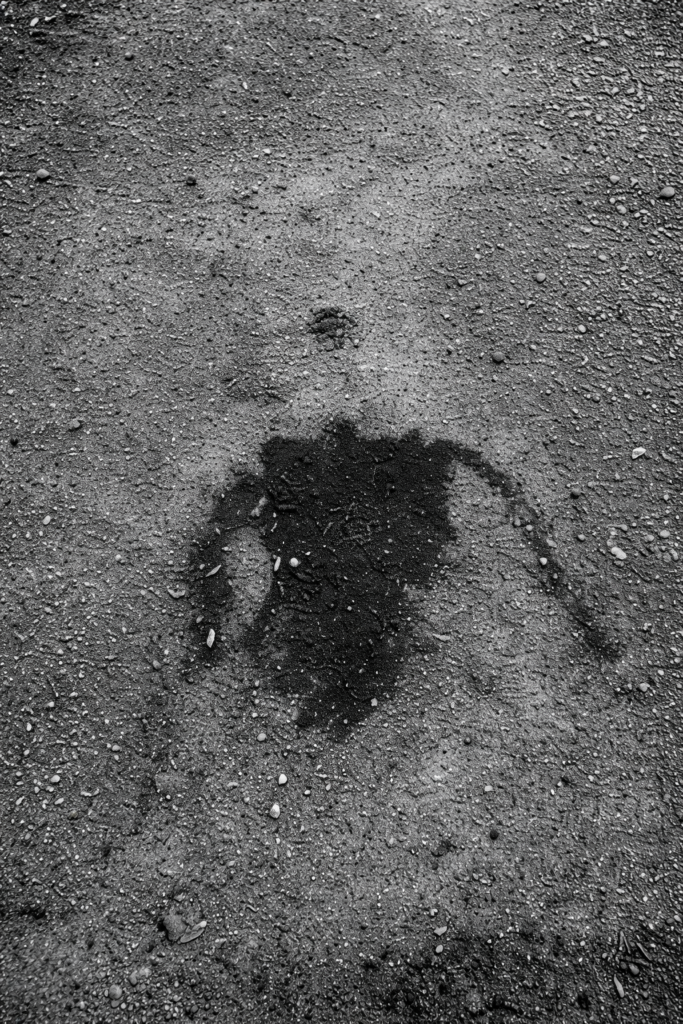
I was walking without expectation when I saw it, a dark imprint pressed into the gravel as though the ground itself had exhaled. At first glance it looked accidental: a spill, a stain, a mark left behind by something already gone. Yet the longer I stood there, the more it felt figurative. Almost bodily. Almost human. There was a shape to it that suggested shoulders, arms, a torso dissolving outward into the dust. Literal it was; evocative it also was. A presence without a body. A remainder without an origin story. In that moment, I read it as trace rather than debris.
I am drawn to these encounters, the places where land appears to hold memory in form rather than language. The stain felt like an echo of labour, of exhaustion, of someone who had leaned, rested, or fallen and then risen again. The earth kept the outline even after the body moved on. Van der Kolk (2014) writes that “traumatized people chronically feel unsafe inside their bodies” (p. 103), that the past lives in them as a gnawing interior discomfort. I think about that in relation to this image: the ground has held the impression of a body long after the body has gone. The earth is also an archive. It keeps the score in its own way, through impression and the quiet persistence of form rather than through narrative.
This image connects directly to what I have been exploring in my 30 Days by the Sea inquiry into alonetude (Tucker, 2026). In that research, I wrote about the body as a somatic archive, the way prolonged exposure to precarious conditions settles into the jaw, the breath, the nervous system, leaving an imprint that persists long after the circumstances that created it have changed. Nixon (2011) calls this slow violence: harm that accumulates invisibly, leaving traces rather than scars. What I saw in this gravel stain was slow violence made legible. A body-shaped mark in the earth, asking to be acknowledged even without a name attached to it.
I chose to leave it undisturbed. I refrained from touching it, reshaping it, or stepping across it. I photographed it as found, honouring the quiet collaboration between chance and perception. This is the ethic that runs through my arts-based practice: restraint as a form of care, witnessing as a form of respect. Nash (2004) describes this as the relational obligation of Scholarly Personal Narrative, to attend carefully to what presents itself without imposing meaning, without demanding confession from what is as yet unready to speak. The surrounding ground is pale, granular, indifferent. Yet at the centre, the darkness gathers, dense, concentrated, almost tender in its insistence that something occurred here.
This image sits within my ongoing exploration of land as witness. What is left behind when movement stops. What impressions remain when stories are no longer spoken. Porges (2011) writes that the nervous system holds histories of safety and threat below the level of conscious awareness. This stain is the earth’s version of that, a subconscious record, a held breath, an impression that outlasted its occasion. The mark will eventually fade, carried off by wind, rain, and footsteps. But for this brief interval, it held form. I photographed it because it felt like the earth saying: I remember.
Photo Credit: Amy Tucker, February 2026
References
Nash, R. J. (2004). Liberating scholarly writing: The power of personal narrative. Teachers College Press.
Nixon, R. (2011). Slow violence and the environmentalism of the poor. Harvard University Press.
Porges, S. W. (2011). The polyvagal theory: Neurophysiological foundations of emotions, attachment, communication, and self-regulation. W. W. Norton.
Tucker, A. (2026). 30 Days by the Sea: A research inquiry into the third shore [Blog]. https://thirdshore.trubox.ca
van der Kolk, B. A. (2014). The body keeps the score: Brain, mind, and body in the healing of trauma. Viking.
Leave a Reply