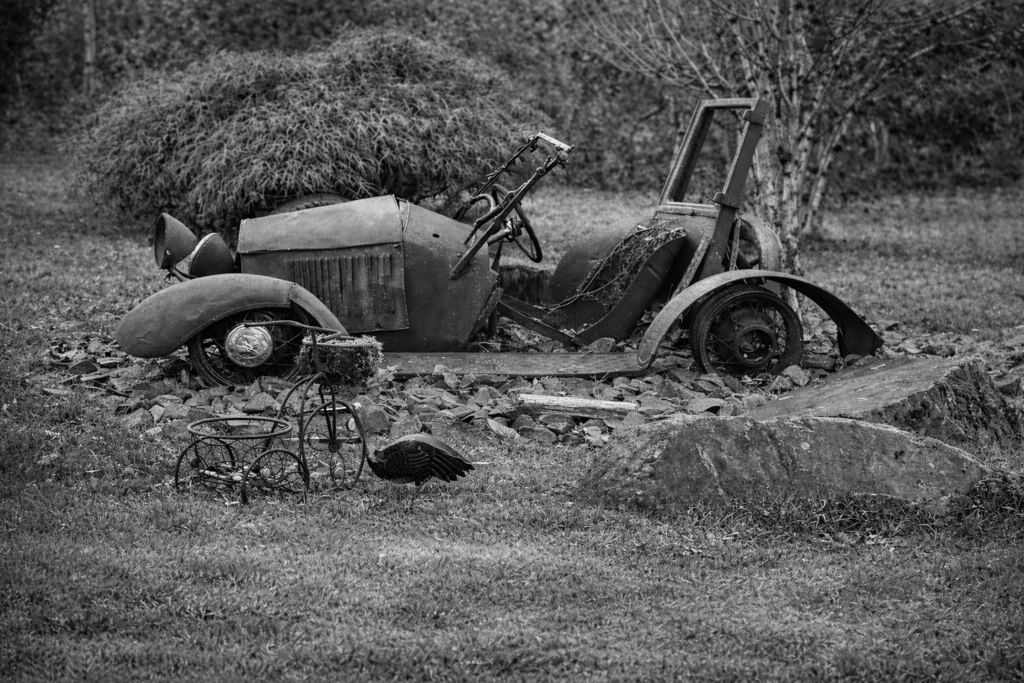
I came across this car while out jogging, not searching for anything in particular, simply moving through the morning in that steady rhythm where body and thought begin to align. It was sitting in an open field, slightly removed from the path, as though it had drifted there and chosen to remain.
I slowed, then stopped. What had been forward motion became stillness. The contrast was immediate. My breath was elevated, my body warm from exertion, while the vehicle before me held an entirely different relationship to time. It had not moved in years. Rust had settled across its surface. Grass had grown around its base. The steering wheel tilted upward, untouched, its purpose suspended.
In black and white, the photograph centres texture rather than nostalgia. The metal reads like skin marked by weather. The tires sink slightly into the ground. A fine network of plant life threads through the seat frame, suggesting not abandonment but absorption. The landscape has not rejected the car. It has begun to fold it inward.
Encountering it mid-run sharpened my awareness of movement and its eventual slowing. I was in motion; it was post-motion. I was passing through; it had arrived at a kind of permanent pause. Scholarly Personal Narrative asks me to read such encounters relationally. The car became less an object and more a mirror—reflecting questions about usefulness, pace, and what happens when identities built on productivity come to rest.
I did not feel sadness standing there. I felt recognition. There is dignity in what remains after function ends. The vehicle no longer carries passengers, yet it carries story. It has shifted from instrument to artifact, from speed to stillness, from labour to witness. Even the small metal bicycle sculpture nearby echoed this transition—two forms of motion held now within a shared field of quiet.
I resumed jogging after taking the photograph, re-entering the rhythm of breath and stride. But I carried the image with me. A reminder that movement is only one phase of existence, and that what we become when we slow down may hold its own kind of meaning.
Leave a Reply