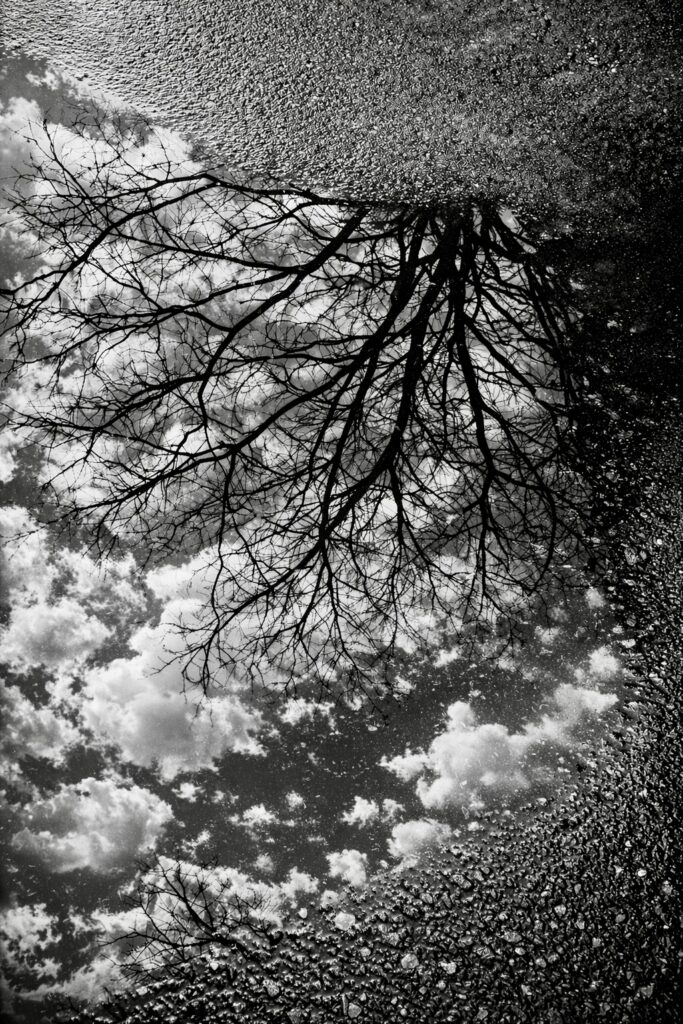
I took this photograph while standing over a shallow rain pool, the kind that forms briefly and disappears without ceremony. At first, I was looking down at stones, ordinary, textured, dry. Then the sky appeared, below my feet rather than above my head. The reflection held clouds in motion and the stark silhouette of a leafless tree stretching outward in quiet reach. What was grounded became atmospheric. What was overhead became submerged. This inversion stopped me.
In my work, I am often drawn to threshold spaces, places where categories soften and perception shifts. The puddle functioned as a temporary portal, holding two realities at once: earth and sky, solidity and reflection, body and atmosphere. The tree, stripped of leaves, appeared skeletal yet expansive, its branches tracing delicate lines across the reflected light. In black and white, the image resists distraction. Texture, contrast, and form take precedence. The stones hold weight; the sky holds breath. This doubling connects directly to what I have been practising in my 30 Days by the Sea inquiry into alonetude (Tucker, 2026), the quality of presence that holds two truths at once: the exhaustion I carried into Loreto and the possibility of something different beginning to form beneath my feet.
I recognize myself in this doubling. Nash (2004) describes Scholarly Personal Narrative as a methodology that asks the researcher to stand inside the frame rather than outside it, to acknowledge how inner landscape and outer landscape speak to one another. In this moment, I felt the convergence of both. I was looking down, and I was also looking inward. The bare branches mirrored the feeling of emotional exposure that accompanies deep reflective work. The clouds suggested movement, transition, impermanence. Nothing fixed. Nothing final. Van der Kolk (2014) writes that “neuroscience research shows that the only way we can change the way we feel is by becoming aware of our inner experience” (p. 209). This puddle, briefly, made that process visible: I was looking at the sky and finding myself.
Black and white photography allows me to remain with essence. It removes the seduction of colour and asks harder questions about structure, shadow, and truth. Porges (2011) explains that the nervous system must perceive safety before it can engage openly with the complexity of experience. I think something analogous is true of visual perception: stripping colour away creates a kind of sensory safety, a reduction of stimulation that allows the eye to attend to what remains, form, light, relationship. Here, the absence of colour feels appropriate. This was a moment of clarity rather than vibrancy. A quiet recognition that reflection, both literal and methodological, requires stillness, requires the willingness to look beneath surface appearances.
The puddle will evaporate. The reflection will vanish. The tree will continue standing elsewhere, unchanged by my witnessing. Yet the encounter remains. This is the work of Scholarly Personal Narrative and of alonetude: to hold fleeting moments as sites of knowledge, to understand that meaning often reveals itself in brief alignments between body, place, and perception. Bollas (2017) calls this the unthought known, knowledge held in the body and in the being, waiting for words to catch up. I left the pool undisturbed. I chose to observe rather than enter it. Some reflections are meant only to be seen.
Photo Credit: Amy Tucker, February 2026
References
Bollas, C. (2017). The shadow of the object: Psychoanalysis of the unthought known. Routledge.
Nash, R. J. (2004). Liberating scholarly writing: The power of personal narrative. Teachers College Press.
Porges, S. W. (2011). The polyvagal theory: Neurophysiological foundations of emotions, attachment, communication, and self-regulation. W. W. Norton.
Tucker, A. (2026). 30 Days by the Sea: A research inquiry into the third shore [Blog]. https://thirdshore.trubox.ca
van der Kolk, B. A. (2014). The body keeps the score: Brain, mind, and body in the healing of trauma. Viking.
Leave a Reply