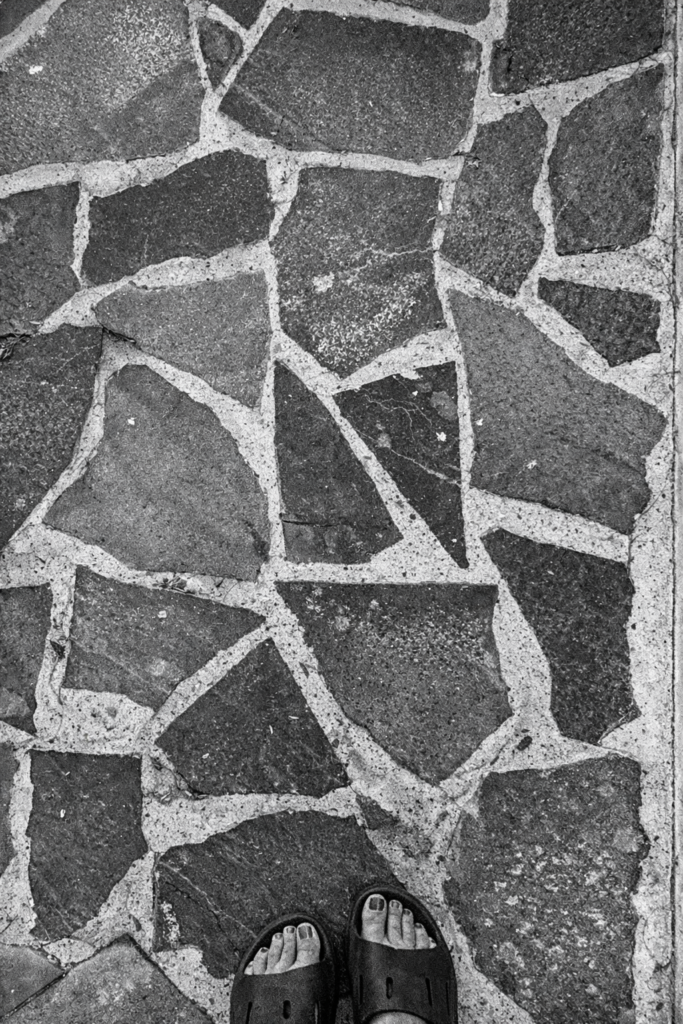
I took this photograph while standing still on a stone path in Loreto Bay, my body paused mid-step. The camera pointed downward, following my gaze. The ground beneath me was uneven, held together by pale mortar and dark stone, each piece shaped by time, weather, and repeated passage. I felt the texture through the soles of my feet before I ever raised the camera. My feet appear at the lower edge of the frame, present without taking over the image. I did nothing to move them into position. I let them remain where they were. The photograph records that moment of pause, when motion softened into attention.
This image belongs to my broader inquiry into what I have been calling alonetude, the third shore I am learning to inhabit by the sea in Loreto (Tucker, 2026). In my 30 Days by the Sea research blog, I described alonetude as the cultivated, sustainable relationship one develops with one’s own company, the capacity to be peacefully and intentionally alone without collapsing into loneliness or reaching for distraction (Tucker, 2026). What I discovered is that this quality of presence cannot be willed into being. It must be grounded, literally. It is learned through the body, through standing, walking, returning, and waiting. This photograph holds that lesson.
Porges (2011) writes that the autonomic nervous system continuously scans for cues of safety through a process he calls neuroception, the detection that occurs below conscious awareness. For much of my career as a precarious academic worker, my nervous system had been in chronic sympathetic activation, braced against the next institutional demand (Tucker, 2026). Standing on this stone path in Loreto Bay, I felt something shift. The unevenness underfoot was a teacher rather than a hazard. The fractured, imperfect stones became evidence that things can hold together precisely because of their differences. Nixon (2011) describes slow violence as harm that accumulates invisibly over time. I have been learning, here by the sea, that slow healing works the same way, quietly, through texture and repetition, through feet that know the ground before the mind catches up.
What I brought to this image was care and restraint. I chose black and white to quiet colour and allow surface and tone to speak. I stayed close to the ground, attending to what was underfoot rather than reaching toward a view. I let the stones remain fractured and imperfect. Light falls evenly across the surface, revealing wear rather than drama. Shadow is subtle here, working quietly as a measure of depth and contact. This way of seeing grows from artists who work with land through patience and ethical distance, including Mark Ruwedel, Awoiska van der Molen, and Jem Southam. Nash (2004) describes scholarly personal narrative as the “unabashed, up-front admission that your own life signifies” (pp. 23-24). In this image, my life, my body, my feet, my pause, signifies. The land requires no performance. It offers passage without evaluation.
This image carries motion held in place. It holds the moment when walking becomes witnessing, and when learning comes from standing long enough to feel the ground beneath the heart. Van der Kolk (2014) writes that “agency starts with what scientists call interoception” (p. 209), the capacity to sense the body’s internal state. I came to this path without knowing I was practising interoception. I came only knowing that something in the ground was asking me to stay. This photograph holds that lesson, grounded in place and carried through the body.
Photo Credit: Amy Tucker, Loreto Bay, January 2026
References
Nash, R. J. (2004). Liberating scholarly writing: The power of personal narrative. Teachers College Press.
Nixon, R. (2011). Slow violence and the environmentalism of the poor. Harvard University Press.
Porges, S. W. (2011). The polyvagal theory: Neurophysiological foundations of emotions, attachment, communication, and self-regulation. W. W. Norton.
Tucker, A. (2026). 30 Days by the Sea: A research inquiry into the third shore [Blog]. https://thirdshore.trubox.ca
van der Kolk, B. A. (2014). The body keeps the score: Brain, mind, and body in the healing of trauma. Viking.
Leave a Reply