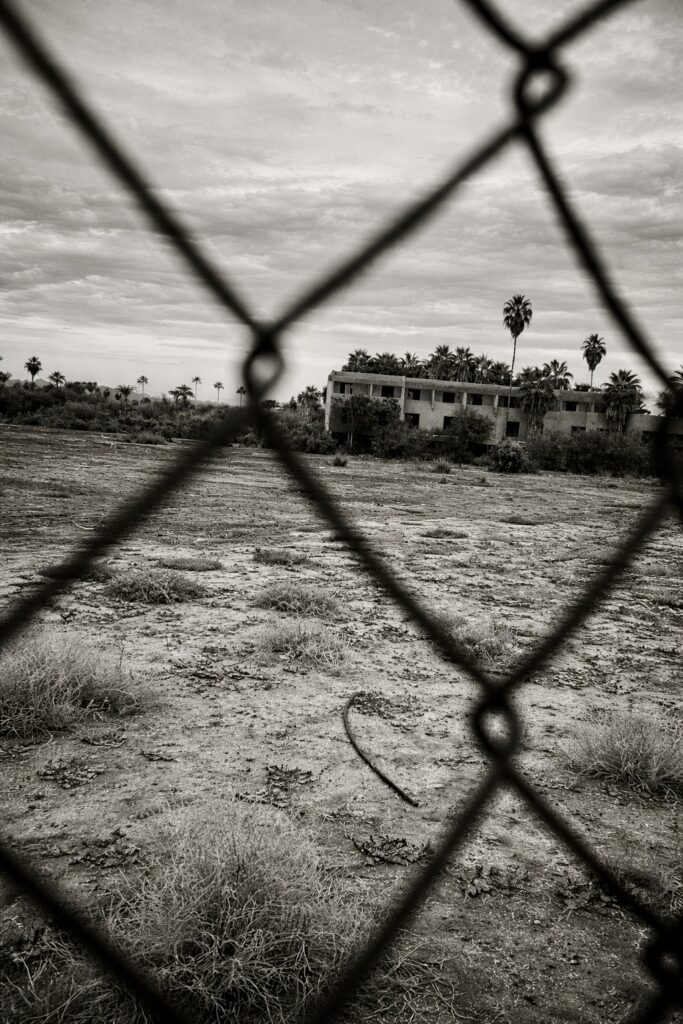
This photograph was taken while walking at the edge of a place I chose to leave unvisited. A chain-link fence marked a boundary between my body and the land beyond it. Rather than crossing, I stopped. I stood still. I allowed the fence to remain present in the frame as a deliberate acknowledgement of distance, history, and responsibility. The land visible through the fence bears signs of abandonment and quiet endurance. The structure in the distance suggests past occupation and withdrawal. The ground holds the texture of long exposure to heat, time, and neglect. Nothing here announces its story. Instead, the image asks for patience. It asks the viewer to remain with what is visible without claiming ownership or resolution.
I have been thinking a great deal about fences during this thirty-day inquiry by the sea in Loreto. The alonetude practice I have been documenting in my 30 Days by the Sea blog (Tucker, 2026) is, in some ways, an inquiry into the fences that have enclosed my working life, the boundaries set by precarious contracts, by institutional hierarchies, by the slow violence Nixon (2011) describes as harm that accumulates gradually and often invisibly. For over twenty-five years, I stood at the edges of institutions that did fully let me in. This photograph knows that feeling. The fence is a fact rather than a symbol. Photographing it from the outside, without forcing entry, without pretending the barrier was absent, became its own form of ethical practice.
This work emerges from my ongoing research into trauma, creativity, and arts-based inquiry, including Photovoice and Scholarly Personal Narrative. Within this research, I treat photography as a relational practice rather than a representational one. The act of photographing becomes a way of listening. The camera functions as a witness rather than an extractor. Nash (2004) describes Scholarly Personal Narrative as a methodology that asks the researcher to acknowledge how their own life is implicated in what they study. Standing at this fence, I felt that implication viscerally. I have spent years hovering at institutional margins, photographing from the outside what others inhabit from within. Porges (2011) might describe the posture I held at this fence as a ventral vagal moment, a state of open, regulated attention rather than defensive withdrawal or anxious approach. I was present. I was watchful. I was choosing to leave what was on the other side to itself.
I am drawn to places shaped by human presence and absence. Abandoned sites, altered landscapes, and restricted grounds hold what I think of as ethical residue. They carry memory without instruction. In these spaces, restraint becomes a form of care. I photograph from the margins because the margins teach me how to look without taking. The fence in this image is central to that lesson. It interrupts access and slows the gaze. It reminds me that some places are encountered through limits rather than entry. This aligns with trauma-informed and decolonizing approaches that prioritize consent, relational accountability, and respect for what cannot be fully known. Van der Kolk (2014) writes that traumatized people “chronically feel unsafe inside their bodies” (p. 103), and I think something analogous happens when we encounter places that have been abandoned or withheld: we feel the residue of unsafety left in the land itself.
I took this photograph as an act of learning. Learning how to remain present without possession. Learning how land communicates through what is left behind. Learning how to witness without crossing. This image belongs to an ongoing body of work that traces my relationship with land across the places I visit. Each photograph is a small pause. Each is an invitation to stay with what remains and to consider how we stand in relation to it. This blog begins from a place of lived research, and this image, this fence, this threshold, this withheld space, is where that research makes itself visible.
Photo Credit: Amy Tucker, January 2026
References
Nash, R. J. (2004). Liberating scholarly writing: The power of personal narrative. Teachers College Press.
Nixon, R. (2011). Slow violence and the environmentalism of the poor. Harvard University Press.
Porges, S. W. (2011). The polyvagal theory: Neurophysiological foundations of emotions, attachment, communication, and self-regulation. W. W. Norton.
Tucker, A. (2026). 30 Days by the Sea: A research inquiry into the third shore [Blog]. https://thirdshore.trubox.ca
van der Kolk, B. A. (2014). The body keeps the score: Brain, mind, and body in the healing of trauma. Viking.
Leave a Reply