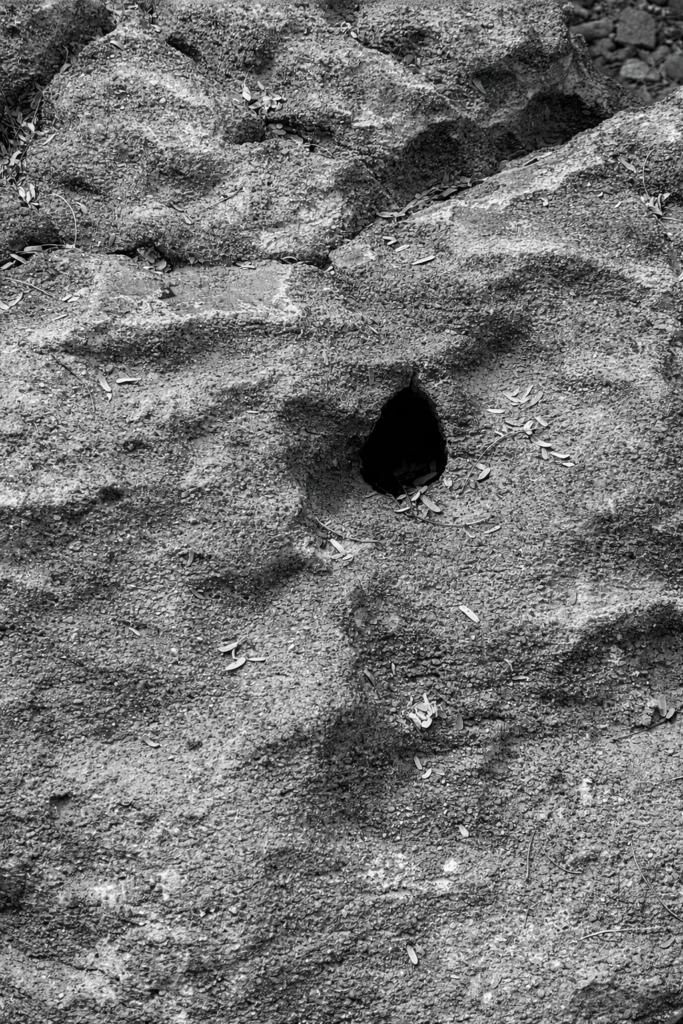
I found this small opening in the earth while walking slowly, eyes cast downward, attending to what the ground might offer. A dark hole, no larger than my fist, pressed into the textured surface of compacted sand and stone. Around it, the land rose and fell in gentle ridges, shaped by water or wind or the patient work of time. Dry leaves scattered across the surface like punctuation. The opening itself revealed nothing. It simply held its darkness and waited.
In black and white, the hole becomes the anchor of the image. It is the darkest point in a field of grey, drawing the eye inward and then refusing to let it pass. I cannot see what lives inside. I cannot know whether this is a home, a refuge, a passage to somewhere deeper, or an abandonment long settled into stillness. The opening offers presence without disclosure. It holds a boundary I am left to honour from the outside. This quality of withheld depth feels important to me in the context of my 30 Days by the Sea inquiry into alonetude (Tucker, 2026). Alonetude is about cultivation rather than transparency. It is the development of an inner life that requires no audience to be real. This opening knows something about that.
I am drawn to thresholds that remain closed to entry. Nash (2004) describes Scholarly Personal Narrative as a methodology that asks the researcher to stand at the edges of what they know and resist the urge to force resolution. This small hole in the earth offered me that exact experience. It asked only that I notice it, photograph it, and move on without disturbing what it protected. Porges (2011) writes about the importance of neuroception, the body’s pre-conscious scan for safety and threat. Standing at this opening, I noticed something unusual: no anxiety, no impulse to reach in or probe. My nervous system was calm. I was simply present with something I could only access at the surface, and that was enough. Van der Kolk (2014) calls it interoception, the capacity to sense the body’s own interior state. I was sensing mine, and it was at rest.
The texture of the ground speaks to slow processes. Erosion and compression. The patient labour of creatures whose work remains invisible to those who walk too quickly. The ridges and grooves record movement that preceded my arrival, shaping I could never replicate. The image becomes a document of accumulated time, of presence that preceded my arrival and will continue long after I have gone. Nixon (2011) describes slow violence as harm that builds invisibly over time, but I find myself thinking that slow care works the same way. The earth has been tending this opening for much longer than I have been walking above it. There is a kind of ethics in acknowledging that.
This photograph sits within my broader practice of ethical witnessing. It asks how we might attend to what the land holds without demanding access. How we might honour depth without extraction. How stillness before an opening can become its own form of respect. The darkness owes me nothing. My role is simply to notice that it exists, to let that noticing change me, and to let that be enough.
Photo Credit: Amy Tucker, Loreto, January 2026
References
Nash, R. J. (2004). Liberating scholarly writing: The power of personal narrative. Teachers College Press.
Nixon, R. (2011). Slow violence and the environmentalism of the poor. Harvard University Press.
Porges, S. W. (2011). The polyvagal theory: Neurophysiological foundations of emotions, attachment, communication, and self-regulation. W. W. Norton.
Tucker, A. (2026). 30 Days by the Sea: A research inquiry into the third shore [Blog]. https://thirdshore.trubox.ca
van der Kolk, B. A. (2014). The body keeps the score: Brain, mind, and body in the healing of trauma. Viking.
Leave a Reply