Artist Statement

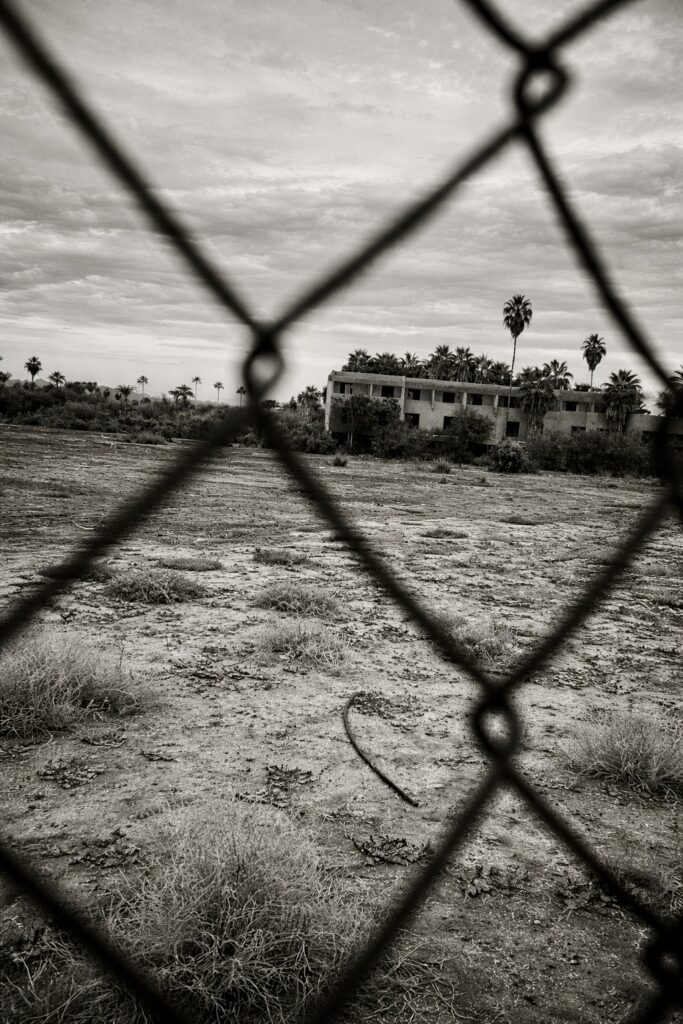
This photograph was taken while walking at the edge of a place I did not enter. A chain-link fence marked a boundary between my body and the land beyond it. Rather than crossing, I stopped. I stood still. I allowed the fence to remain present in the frame as a deliberate acknowledgement of distance, history, and responsibility.

The land visible through the fence bears signs of abandonment and quiet endurance. The structure in the distance suggests past occupation and withdrawal. The ground holds the texture of long exposure to heat, time, and neglect. Nothing here announces its story. Instead, the image asks for patience. It asks the viewer to remain with what is visible without claiming ownership or resolution.

This work emerges from my ongoing research into trauma, creativity, and arts-based inquiry, including Photovoice and Scholarly Personal Narrative. Within this research, I treat photography as a relational practice rather than a representational one. The act of photographing becomes a way of listening. The camera functions as a witness rather than an extractor.

I am drawn to places shaped by human presence and absence. Abandoned sites, altered landscapes, and restricted grounds hold what I think of as ethical residue. They carry memory without instruction. In these spaces, restraint becomes a form of care. I photograph from the margins because the margins teach me how to look without taking.

The fence in this image is central to that lesson. It interrupts access and slows the gaze. It reminds me that some places are encountered through limits rather than entry. This aligns with trauma-informed and decolonizing approaches that prioritize consent, relational accountability, and respect for what cannot be fully known.

I took this photograph as an act of learning. Learning how to remain present without possession. Learning how land communicates through what is left behind. Learning how to witness without crossing.

This image belongs to an ongoing body of work that traces my relationship with land across the places I visit. Each photograph is a small pause. Each is an invitation to stay with what remains and to consider how we stand in relation to it.

Photo Credit: Amy Tucker, January 2026
This blog begins from a place of lived research.
My work in trauma, creativity, and arts-based inquiry has taught me that knowledge does not arrive only through words or analysis. It often arrives through the body, through pause, through what is noticed when the nervous system softens enough to listen. Ethical Shadows emerged from this understanding and from my ongoing research into trauma-informed pedagogy, creative practice, and visual methods such as Photovoice.
In my academic work, Photovoice has shown me that images can hold what language cannot. Photographs allow participants and researchers to speak without overexposure. They make space for complexity, silence, and consent. They invite reflection rather than demand explanation. Over time, I began to notice that the most powerful moments in this work were rarely the most dramatic images. They were the quiet ones. The images were taken after something had happened. The images that stayed close to the ground.
This blog grows out of that noticing.
Much of my research explores how trauma lives in bodies, in institutions, and in land. Trauma leaves subtle marks. It shows up in patterns of avoidance, in fragmentation, in pauses where motion used to be easy. Creativity offers a way to approach these places with care. Arts-based research allows space for learning that moves slowly, that values presence over performance, and that honours what remains rather than what is missing.
Working with land has become central to this inquiry. I approach the place as a teacher rather than a backdrop. Shorelines, stone paths, pavement, interior tables, and shadowed surfaces hold memory through wear, erosion, and repeated passage. They carry knowledge shaped by time rather than events. When I photograph these places, I am not documenting them. I am listening to them.
The images in Ethical Shadows are made through return and restraint. I work in black and white to reduce distraction and allow surface, tone, and texture to speak. Shadow functions as a method rather than an effect. It creates boundaries and protection. It allows presence without disclosure. In many of the images, the body appears only partially or indirectly. This is intentional. It reflects a trauma-informed ethic that values consent, distance, and care.
This practice is deeply connected to my research in higher education, leadership, and pedagogy. I am interested in how learning happens when urgency is removed. I am interested in what becomes possible when we slow down enough to notice what is underfoot. In Photovoice, participants often speak about seeing differently after making images. Here, I am practicing that same shift in my own work.
Loreto Bay has been an important site of learning for this inquiry. The land there holds long histories without explanation. It teaches through stillness. It asks for attention rather than interpretation. Many of the images in this blog were made while walking, pausing, standing still, and feeling the ground before lifting the camera. Motion matters here, but so does the moment when motion softens into attention.
Ethical Shadows exists as a space to hold that kind of learning. It brings together research and practice, trauma and creativity, land and body. It is an invitation to look carefully, to move slowly, and to learn from what remains.
This is where the work begins.
Leave a Reply