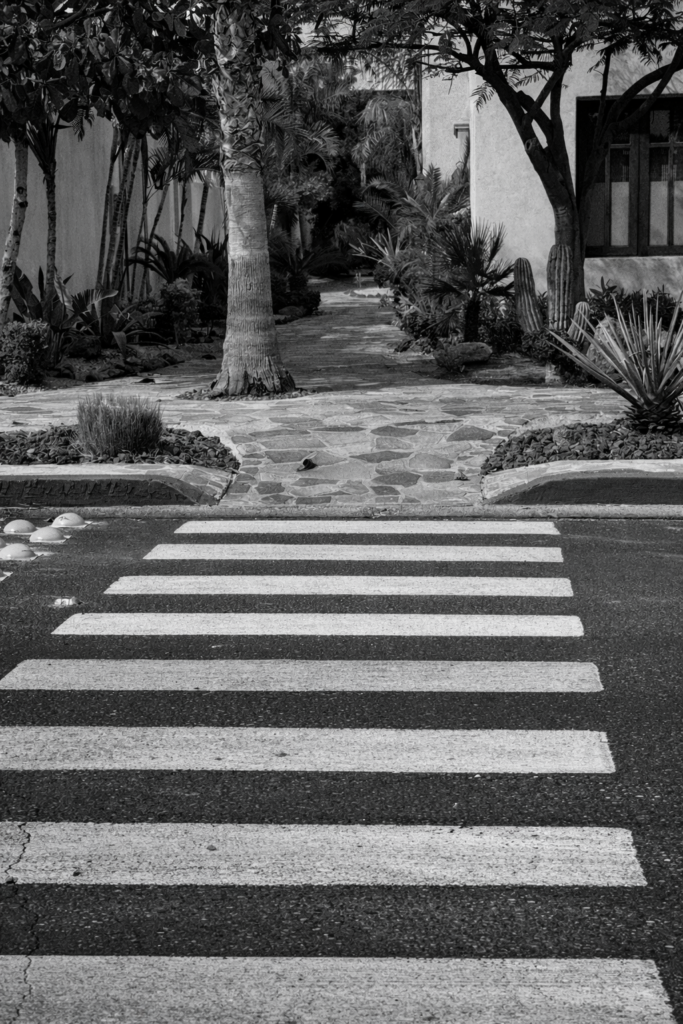
I took this photograph while walking in Loreto, noticing how the painted lines of the crosswalk interrupted the landscape and guided the body forward. The crosswalk became a threshold for me. It marked a moment of movement between where I had been and where I was going, between institutional belonging and personal becoming. In black and white, the scene shifts from a colourful resort walkway into a study of passage. The ordered stripes of the road meet the uneven textures of stone, palm, and desert plants. I felt the tension between structure and growth, between systems that organize bodies and the quiet, living pathways that emerge beyond them. The path beyond the crosswalk disappears into shade and foliage, suggesting that transition is rarely linear or fully visible.
This image sits within what I have been developing over thirty days by the sea as an inquiry into alonetude, the third shore between imposed loneliness and chosen solitude (Tucker, 2026). Bridges and Bridges (2019) describe the neutral zone as the disorienting space between an ending and a new beginning, the in-between state where the old identity has dissolved but the new one has yet to fully form. This crosswalk, to me, is that neutral zone made visible. I am crossing. I have yet to fully know what I am crossing into. For years, I believed my belonging rested in institutional rhythms, student needs, colleague expectations, and the fragile promise of contract renewal. Standing here, camera in hand, I began to sense another form of belonging. The land requires no performance. It offers passage without evaluation.
Porges (2011) explains that the nervous system must perceive safety before it can engage openly with the world. For much of my career, I crossed institutional thresholds while my body remained braced, scanning for the next demand, the next reminder of contingency. Nixon (2011) calls this slow violence: the harm that accumulates invisibly through precarious conditions rather than arriving as a single dramatic event. This crosswalk in Loreto offered something different. The stripes were orderly, yes, but beyond them lay open space, unmanaged growth, and a path that chose its own direction. Nash (2004) writes that Scholarly Personal Narrative asks the researcher to stand inside their own experience rather than observe it from a distance. I am standing inside this threshold image. I am the body that crossed it.
Walking, photographing, and noticing have become methods of recovery and research during this residency. Each step across the threshold is both an embodied practice and data. The land becomes a co-teacher, offering pathways that invite slowing, noticing, and choosing presence over productivity. Van der Kolk (2014) writes that “agency starts with what scientists call interoception” (p. 209), the body’s capacity to sense its own internal state. I have been practising interoception on these walks, learning to feel the difference between a body braced for threat and a body moving freely through open space. This crosswalk became a quiet declaration that I can cross into a different relationship with work, place, and self. This photograph is part of an arts-based research practice that uses walking and photography as methods of witnessing. It documents a moment of transition and asks how thresholds shape identity, memory, and healing.
Photo Credit: Amy Tucker, January 2026
References
Bridges, W., & Bridges, S. (2019). Transitions: Making sense of life’s changes (40th anniversary ed.). Balance.
Nash, R. J. (2004). Liberating scholarly writing: The power of personal narrative. Teachers College Press.
Nixon, R. (2011). Slow violence and the environmentalism of the poor. Harvard University Press.
Porges, S. W. (2011). The polyvagal theory: Neurophysiological foundations of emotions, attachment, communication, and self-regulation. W. W. Norton.
Tucker, A. (2026). 30 Days by the Sea: A research inquiry into the third shore [Blog]. https://thirdshore.trubox.ca
van der Kolk, B. A. (2014). The body keeps the score: Brain, mind, and body in the healing of trauma. Viking.
Leave a Reply