I came to the sea to learn how to be still again.
After twenty-five years of precarious academic labour, the endless contracts, the performed gratitude, the body always braced for the next uncertainty, I arrived in Loreto with a nervous system that had forgotten what safety felt like. Van der Kolk (2014) writes that the body keeps the score. Mine was keeping a tally I could no longer afford to pay. And then, this pigeon.
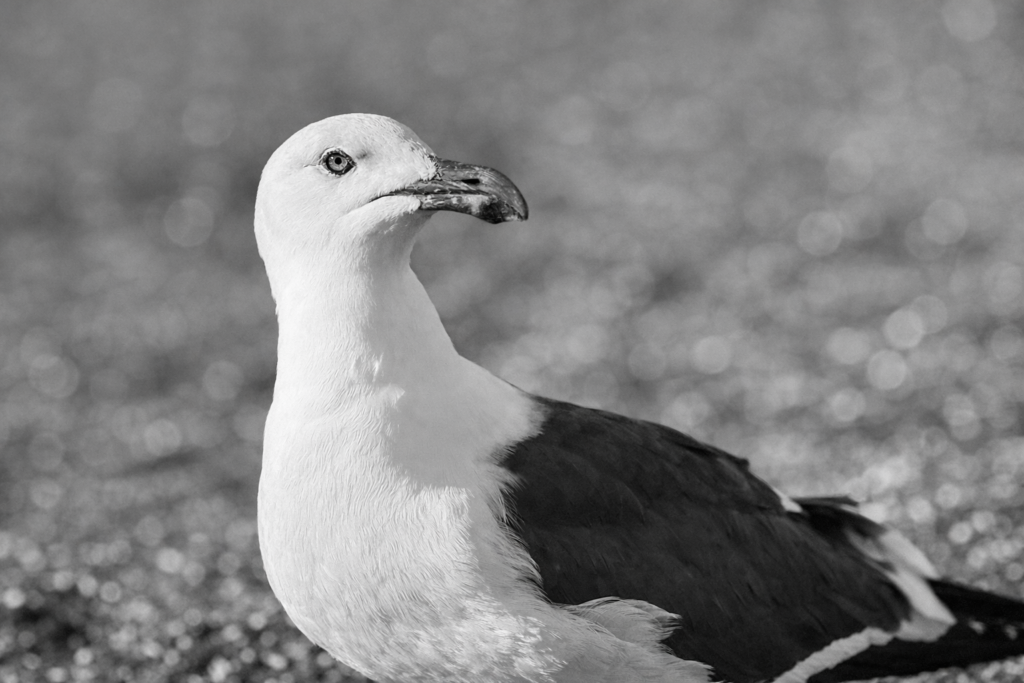
I was walking the shoreline when I noticed it standing at the edge of things, present without fleeing or grasping. So still. So here [Tan quieto. Tan presente.]. Something in its posture stopped me. The bird was doing what I was trying to remember how to do: occupying a threshold without anxiety, watching without the need to fix or flee or perform. This is the quality of presence I have been naming alonetude in my parallel inquiry at 30 Days by the Sea (Tucker, 2026), the third shore between imposed loneliness and chosen solitude, the inner condition where one inhabits one’s own company without collapsing or performing. The pigeon was practising nothing. It was simply being. That, I am learning, is the hardest thing.
I chose black and white because colour felt like too much. My nervous system was learning to tolerate simplicity again, what Porges (2011) might call the slow return to ventral vagal safety, the state where we can finally rest because we sense, at last, that we are safe. Stripping away colour became its own kind of healing practice. What remains is texture, light, shadow, presence. What remains is enough. This connects to what environmental psychologists Kaplan and Kaplan (1989) call soft fascination, the kind of gentle, effortless attention that natural objects invite, allowing directed attention to recover from the depletion caused by sustained cognitive effort. This bird, in this light, on this shore, became exactly that: a site of soft fascination that asked only that I notice.
This image belongs to my inquiry into alonetude, the third shore I am learning to inhabit, the liminal space between the loneliness that was imposed upon me and the solitude I am choosing now (Tucker, 2026). Alonetude names the labour of transforming structural harm into something generative. It refuses to pathologise exhaustion as personal failure. It insists that withdrawal can be protective, that attention can be medicine, that small acts of witnessing can become acts of care. Nixon (2011) describes slow violence as harm that accumulates invisibly over time through precarious conditions. I have been living inside that slow violence for over two decades. What this bird offered me, and what this thirty-day residency is offering me, is the slow counter-movement: presence accumulating quietly, one shore walk at a time.
The pigeon does nothing to teach me anything. It simply stands where land meets sea, holding its ground without effort. Greenspan (2003) writes about befriending the dark emotions, grief, fear, despair, rather than bypassing them. I think there is something similar in befriending stillness. Forcing peace is unnecessary; allowing it is the practice. Performing recovery can be set aside; witnessing the moments when the body, unbidden, begins to soften is what matters. Nash (2004) describes Scholarly Personal Narrative as the “unabashed, up-front admission that your own life signifies” (pp. 23-24). My life signifies here, in the exhaustion, in the arrival, in the strange grace of watching a bird stand still long enough to teach me something about what I had forgotten I needed.
Here I am. Here I stay [Aquí estoy. Aquí me quedo.].
This photograph is about what happens when a body that has been running finally stops. It is about the courage it takes to do nothing when everything in your training says produce, perform, prove your worth. It is about discovering that presence, quiet, attentive, undemanding presence, might be the most radical thing I can offer myself, and perhaps, eventually, the world. The shoreline holds both of us: the pigeon and me, learning how to stay.
Photo Credit: Amy Tucker, Loreto, January 2026
References
Greenspan, M. (2003). Healing through the dark emotions: The wisdom of grief, fear, and despair. Shambhala.
Kaplan, R., & Kaplan, S. (1989). The experience of nature: A psychological perspective. Cambridge University Press.
Nash, R. J. (2004). Liberating scholarly writing: The power of personal narrative. Teachers College Press.
Nixon, R. (2011). Slow violence and the environmentalism of the poor. Harvard University Press.
Porges, S. W. (2011). The polyvagal theory: Neurophysiological foundations of emotions, attachment, communication, and self-regulation. W. W. Norton.
Tucker, A. (2026). 30 Days by the Sea: A research inquiry into the third shore [Blog]. https://thirdshore.trubox.ca
van der Kolk, B. A. (2014). The body keeps the score: Brain, mind, and body in the healing of trauma. Viking.
Leave a Reply