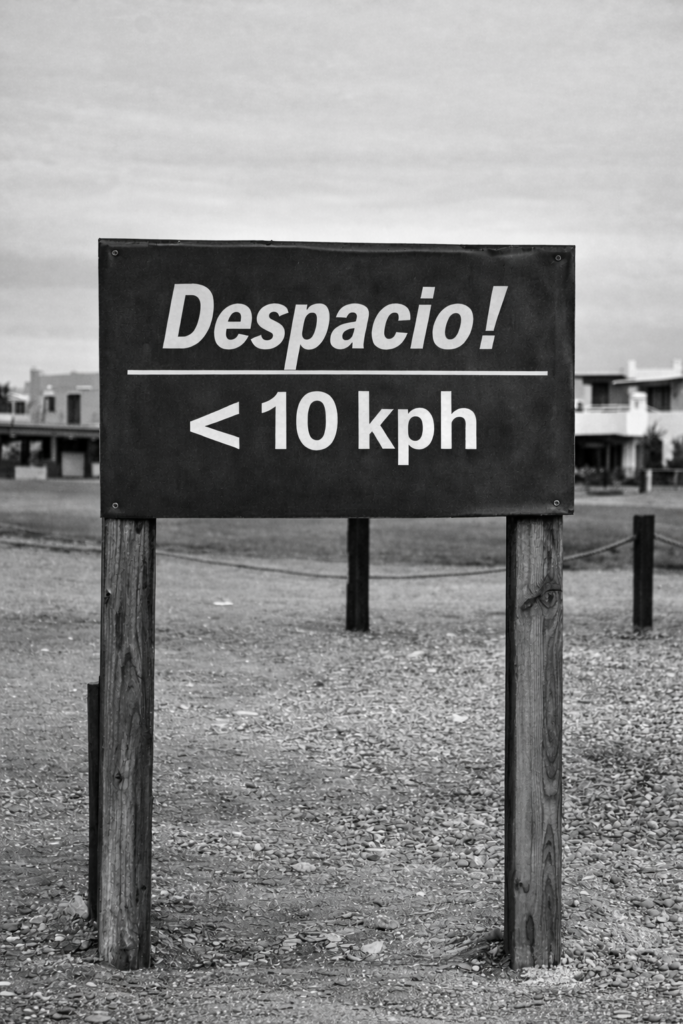
I took this photograph while walking slowly along a gravel road in Loreto. The sign stood alone, mounted on weathered wooden posts, its message offered first in Spanish and then in numbers. Despacio! Slow down. Less than ten kilometres per hour.
The sign speaks before it measures. It assumes that the body arriving here might need the word before the figure, the command before the calculation. I stood in front of it for a long time, noticing how the gravel spread unevenly beneath, how the low buildings in the distance seemed unhurried, how the overcast sky flattened everything into tones of grey. In black and white, the sign loses none of its directness. If anything, the reduction clarifies. The exclamation mark carries weight. The wooden posts show their grain, their age, their quiet insistence on staying upright. The gravel holds no single path. Movement here is prescribed toward slowness alone.
In my 30 Days by the Sea inquiry into alonetude, I have been documenting what happens when a body trained by precarity to move fast, produce constantly, and remain perpetually available finally receives permission to slow down (Tucker, 2026). Nixon (2011) describes slow violence as harm that accumulates invisibly, the grinding, unglamorous attrition of precarious labour. What I am discovering, here in Loreto, is that recovery from slow violence requires equally slow medicine. Kaplan and Kaplan (1989) call this restorative attention, the kind of effortless noticing that natural and unhurried environments invite, allowing the depleted mind and body to recover their capacity for engaged presence. This sign, with its simple command, felt like the landscape extending that same invitation to me personally: Despacio. Slow down. The word arrived as a practice rather than a traffic instruction.
I am drawn to signs that instruct the body. Crosswalks, thresholds, fences, postings. They reveal what a place expects of those who enter, what pace is permitted, what language is assumed. This sign interested me because it leads with Spanish. It does offer a translation. It trusts that whoever arrives will find their way to understanding, or will simply obey the feeling of the word itself. Despacio. Slow down. The sound alone asks for slowness. Porges (2011) writes that the body responds to prosodic cues, to the rhythm and tone of language, as signals of safety or threat. The word despacio is itself a prosodic event. It is soft in the mouth. It decelerates the breath.
Nash (2004) argues that Scholarly Personal Narrative asks the researcher to trust that their own encounters with the world constitute legitimate data. I am learning to trust this. I am learning that the moment I stood before this sign and felt something loosen in my chest, something that had been clenched for twenty-five years of precarious work, was personal and also evidence. Evidence that the body responds to permission when permission is offered simply and without condition. This photograph holds that moment. It holds the instruction I needed and was only beginning to believe I deserved to follow.
Photo Credit: Amy Tucker, Loreto, January 2026
References
Kaplan, R., & Kaplan, S. (1989). The experience of nature: A psychological perspective. Cambridge University Press.
Nash, R. J. (2004). Liberating scholarly writing: The power of personal narrative. Teachers College Press.
Nixon, R. (2011). Slow violence and the environmentalism of the poor. Harvard University Press.
Porges, S. W. (2011). The polyvagal theory: Neurophysiological foundations of emotions, attachment, communication, and self-regulation. W. W. Norton.
Tucker, A. (2026). 30 Days by the Sea: A research inquiry into the third shore [Blog]. https://thirdshore.trubox.ca
Leave a Reply