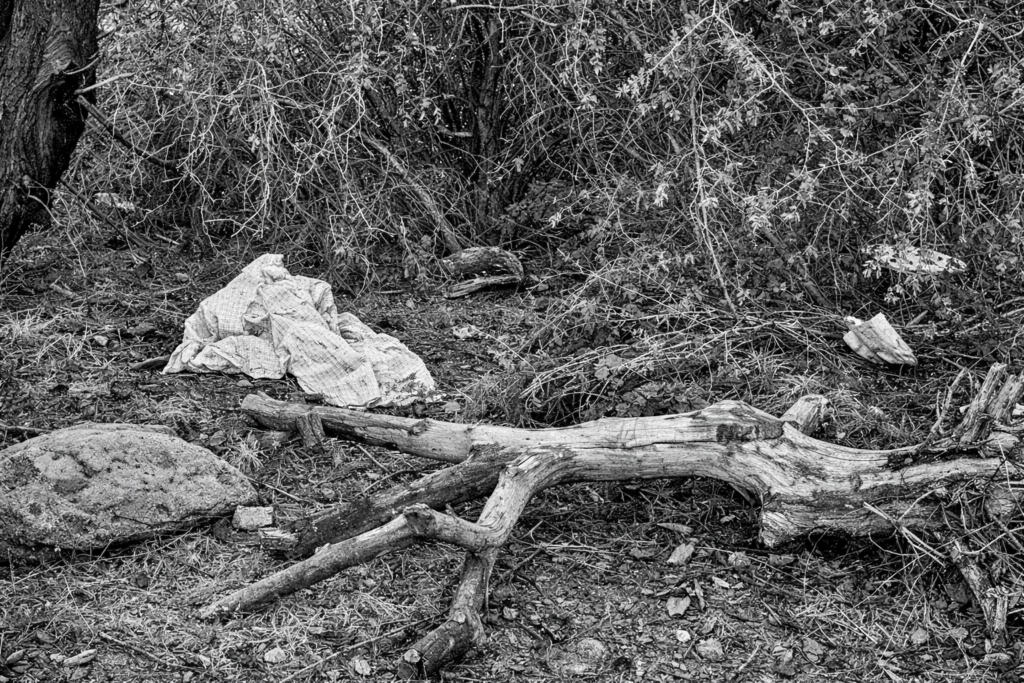
I came upon this scene while walking through the brush outside Loreto. A crumpled cloth lay against the ground, pale and softened by weather, resting beside a fallen branch stripped of its bark. Stones, dry twigs, and tangled scrub surrounded the fabric, which held a shape that suggested it had once wrapped something, or someone. The image stopped me before I fully understood why.
In black and white, the cloth becomes the brightest element in a field of grey and shadow. It draws the eye the way absence draws attention. Something was here. Something is gone. What remains is the residue of presence, a trace that refuses to narrate its own story. The branch beside it lies heavy and still, its limbs reaching in multiple directions like a body at rest. The ground holds both objects without distinction, accepting what has been left as simply what is. This is a scene of aftermath. Nixon (2011) writes that slow violence leaves marks that accumulate in landscapes, in bodies, and in the material residue of lives that institutions have failed to acknowledge. I recognized something of that residue in this cloth. It withheld its history. It simply persisted.
In my 30 Days by the Sea inquiry into alonetude (Tucker, 2026), I have been sitting with the question of what it means to acknowledge what remains after prolonged exposure to precarious conditions. Van der Kolk (2014) writes that “traumatized people chronically feel unsafe inside their bodies” (p. 103), that the past lives on in the form of interior discomfort, a residue the body holds long after the circumstances have changed. I think of this cloth in those terms. It has been left. It has been rained on. It has softened. It is with us still, though changed by everything that passed through the space around it. I know something of that process. The residue of twenty-five years of precarious academic labour has settled into my jaw, my breath, my nervous system (Tucker, 2026). Coming to Loreto has been, in part, an effort to begin noticing what remains, to witness it rather than to narrate it.
In my scholarly and personal life, I have often encountered what is left behind. The residue of contracts that ended without ceremony. The traces of labour that institutions absorbed without acknowledgement. The quiet accumulation of effort that remains visible only to those who know where to look. This photograph speaks to that experience without insisting on equivalence. The cloth is itself. I found it, held by the ground, witnessed by my camera, and offered here without resolution. Nash (2004) argues that Scholarly Personal Narrative asks the researcher to name their own experience without reducing it to symbol or allegory. My history is itself. The resonance between them is real, and real is enough.
The land receives what is left upon it without judgment. It holds the discarded alongside the lost with equal care. In holding, it teaches me something about what it means to witness without demanding explanation. Porges (2011) describes the ventral vagal state as one in which the body can engage with the world openly, without defensive withdrawal. Standing before this cloth, I felt that kind of open witnessing: no urgency, no need to fix, no story I had to impose. The cloth will fade. The branch will soften and return to soil. What persists is the practice of noticing, of pausing long enough to honour what remains even when its story is incomplete.
Photo Credit: Amy Tucker, Loreto, January 2026
References
Nash, R. J. (2004). Liberating scholarly writing: The power of personal narrative. Teachers College Press.
Nixon, R. (2011). Slow violence and the environmentalism of the poor. Harvard University Press.
Porges, S. W. (2011). The polyvagal theory: Neurophysiological foundations of emotions, attachment, communication, and self-regulation. W. W. Norton.
Tucker, A. (2026). 30 Days by the Sea: A research inquiry into the third shore [Blog]. https://thirdshore.trubox.ca
van der Kolk, B. A. (2014). The body keeps the score: Brain, mind, and body in the healing of trauma. Viking.
Leave a Reply